 |
Labrador Iron MinesHoldings Limited |
|
 |
Corporate Information
|
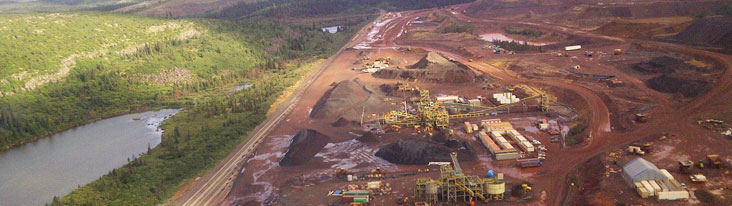
Company OverviewLabrador Iron Mines ("LIM") is engaged in the mining of iron ore and in the exploration and development of direct shipping iron ore projects in the central part of the prolific Labrador Trough region, one of the major iron ore producing regions in the world, situated in the Menihek area in the Province of Newfoundland and Labrador and in the Province of Quebec, centered near the town of Schefferville, Quebec. LIM's Schefferville Projects are connected by a direct railway to the Port of Sept-Iles on the Atlantic Ocean and benefit from established infrastructure, including, the town, airport, roads, hydro power and rail service. LIM holds measured and indicated mineral resources of approximately 54.8 million tonnes at an average grade of 56.8% Fe and inferred resources of 5.0 million tonnes at an average grade of 55.6% Fe on its Schefferville Projects. (NI 43-101 Technical Report, “Technical Report: Schefferville Area Phase 1 DSO Iron Projects Resource Update, Western Labrador – NE Quebec, Canada” dated effective June 27, 2014, reports resources as at March 31, 2014. ) In the three-year period of 2011, 2012, and 2013, LIM completed and sold a total of 3.6 million dry metric tonnes of iron ore, all of which was sold in 23 cape-size shipments into the China spot market. LIM has not undertaken mining operations since 2013, primarily due to the low iron ore price, but maintains its properties on a stand-by care and maintenance basis and, subject to securing financing, is positioned to resume mining operations as soon as the iron ore price and economic conditions warrant. The Company continues maintain its mineral claims in good standing. HOUSTON IRON ORE PROPERTY The Houston Project (“Houston”), which includes the Houston deposit and the Malcolm deposit, is planned as LIM’s next DSO project. Houston is situated in Labrador about 25 km southeast of the town of Schefferville. Together with the Malcolm Deposit, considered to be its northwest extension, the Houston deposits are estimated to contain a NI 43-101 resource of 40.6 million tonnes grading 57.6% Fe. LIM has identified a higher-grade component of this resource, 20 million tonnes at an average grade of 62% Fe, at a 58% cut- off grade, that is amenable to dry crushing and screening. [NI 43-101 compliant technical report, entitled “Technical Report: Schefferville Area Phase 1 DSO Iron Projects Resource Update, Western Labrador – NE Quebec, Canada” dated effective June 27, 2014, reports resources as at March 31, 2014. Refer to “Qualified Persons” section] The initial mine plan will focus on this higher-grade component. The revised development plan is based on lower-cost dry crushing and screening only. When in full production, the Houston-Malcolm deposits are expected to produce consistent saleable product of about 2 million tonnes per year, with an initial mine-life of 10 years. The Houston deposits also contain harder ore than the Jamesmine and are anticipated to produce a larger proportion of premium lump product. The capital investment to put Houston into production is relatively modest, and the lead time for development relatively short, compared with most other iron ore projects under development in the Labrador Trough. Subject to securing financing, the Company is positioned to pursue development of the Houston Project and resume mining operations as soon as economic conditions warrant. Development of the Houston Project is subject to the availability of development financing, the current iron ore price and certain economic conditions. ELIZABETH TACONITE PROJECT LIM’s Elizabeth Taconite Project is located approximately four kilometres (“km”) west of LIM’s former James Mine and is advantageously situated about 5.5 km from the town of Schefferville. The project benefits from direct access to existing roads, rail bed and power line corridor. Access to the project area is via an existing mine road. The Elizabeth Taconite Project has an independent NI 43-101 Inferred mineral resource estimate, as at June 15, 2013, comprising two adjacent deposit areas. Approximately 620 million inferred tonnes at an average grade of 31.8% Fe have been estimated in Elizabeth No. 1 and a potential 350 million to 600 million tonnes at an average grade 31.9% Fe have been estimated in Elizabeth No. 2. [NI 43-101 compliant technical report, entitled "Mineral Resource Technical Report: Elizabeth Taconite Project Labrador” dated effective June 15, 2013. Refer to “Qualified Persons” section] The initial Elizabeth target measures approximately 4 km long and is made of magnetite and hematite dominant zones. There is significant potential for resource expansion as the deposit remains open along strike to the northwest and southeast. Airborne and ground geophysics have also highlighted the Gagnon taconite target, located in Quebec, a few km from the Elizabeth Taconite Project. Taconite deposits, such as the Elizabeth Taconite Project, are typically low-grade but high-tonnage deposits which require upgrading through a concentrator involving a major capital investment which could produce a high-grade saleable iron ore product higher than 68% Fe, which would attract premium prices in today’s iron ore market. Elizabeth represents an opportunity for LIM to develop a major new taconite operation in the Schefferville region of the Labrador Trough.
|
Home | Corporate Information | Shareholder Information | Projects | Environment & Social | News Center | Contact Us © 2024 Labrador Iron Mines All Rights Reserved | Disclaimer & Privacy Policy |