Labrador Iron Mines

Holdings Limited

TSX: LIM


  Home
  Corporate Information
  Projects
  Environment & Social
  Investors Centre
  Financials
  Press Releases
  Contact Us


Schefferville Area Properties

Location
Phase 1 - James
- Redmond
- Knob Lake
- Houston
Phase 2 - Astray Lake
- Sawyer Lake
Phase 3 - Howse
- Kivivic No. 1 & 2
 
Geology
Deposit Types
Mineral Resources & Reserve Estimates
Transportation & Infrastructure
Mining & Processing
Iron Ore Products & Markets

Schefferville Area Project

The Company's Project is located in the western central part of the Labrador Trough iron range, one of the most prolific iron ore producing regions in the world, within the Province of Newfoundland and Labrador and about 350km north of the seaport of Sept-Iles. Access to the area is by rail from Sept-Iles or by air from Montreal to Sept-Iles. The eight iron ore deposits comprising the Project are direct-shipping hematite lump and sinter fine ores lying within 2km to 65km from the town of Schefferville, Quebec - namely, the James, Redmond, Houston, Knob Lake, Astray, Sawyer, Howse and Kivivic deposits. The projects were discovered by IOC during the period it operated direct shipping iron ore at Schefferville.

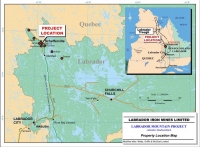
Project Location Map

LIM holds interests in 34 Mineral Rights Licenses covering approximately 8,400 hectares in the western central part of the Labrador Trough iron range of Western Labrador, within the Province of Newfoundland and Labrador, near the town of Schefferville, Quebec. These licenses are subject to a royalty of 3% of the selling price FOB port of iron ore produced and shipped from the properties.

The Schefferville area is one of the largest iron ore producing regions in the world with a tradition that dates back to the early 1950s. The properties comprising LIM's Project were part of the original IOC Schefferville operations and formed part of the 400 million tons of reserves and resources identified by IOC. An historic estimate of approximately 90 million tons of hematite iron ore was prepared according to the standards used by IOC but is not compliant with National Instrument 43-101 [Technical Report of an Iron Project in Northwest Labrador Province of Newfoundland and Labrador dated September 10, 2007 and amended October 10, 2007 by SNC-Lavalin Inc.] posted on SEDAR. These properties include the James and Redmond deposits on which initial mining or development activities had been undertaken by IOC and where LIM plans to initiate its first phase of production.

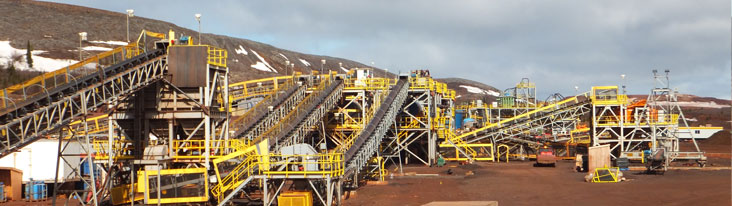
Mining will be by open-pit methods and broken ore will be screened and washed prior to rail shipment. The ore excavated is estimated to contain around 56% to 58% iron and it is expected that the beneficiation process will enhance the product grade to around 65% iron and remove unwanted material. Two products will be produced, namely coarse lump ore and a finer sinter feed. Approximately one-quarter of the product will be lump ore. Most of the existing roads that provide access to the different properties designated for early development (James, Redmond, Houston and Knob Lake) require minimal up-grading.

These products will be transported by the existing railroad systems to the port of Sept-Îles on the St Lawrence River for onward shipping, most likely to steel mills in Europe. The lower shipping costs for the shorter shipping distances to such markets compared with other major iron ore producing regions is advantageous to LIM. However, continued growth in demand for iron ore particularly from China may also provide additional market opportunities in the foreseeable future. The whole operation will utilize well proven, relatively basic technology and closely reflect that previously carried out by the Iron Ore Company of Canada in the same general location for almost thirty years from 1954 to 1982.


Past Exploration

Most of the exploration on the Properties was carried out by IOC until the closure of their Schefferville operations in 1982, in response to technological changes in the steel industry and the emphasis on concentrating and pelletizing ores. A large amount of high quality historical IOC data has been recovered and reviewed by LIM.

Historic Mining

Commencing in 2005, LIM initiated a limited exploration/ reconnaissance and rock sampling program on its claims in the Schefferville area. The program included the survey of existing IOC trenches, pits and geological features for the geo-referencing of the local grids into UTM system. The program also included sampling of trenches and outcropping mineralization for grade verification.

Results obtained were expectedly similar to those reported by IOC. LIM also completed a drilling and trenching program in 2006 at James and Houston 1, twinning existing trenches completed by IOC.

During 2008, LIM expanded its management and operating team with a number of senior appointments, initiated further activities to advance the developmental stages of the Project spending over $12 million on field programmes and awarded various contracts, including environmental baseline studies, detailed exploration drilling, bulk sampling, resource estimation, metallurgical process testing, rail and port studies and engineering design, all directed to move the Schefferville Project forward towards initial production in 2010.

2008 Drilling Program

From July to October 2008, LIM carried out an extensive exploration program which included detailed topographic aerial surveys, RC drilling, diamond core drilling, trenching, bulk sampling and surveying of historical drill holes and trenches.

Knob Lake Drilling

LIM's 2008 drilling program comprised 69 RC drill holes with two drills totalling over 4,000m conducted by Cabo Drilling and supervised by SGS Geostat Ltd. The RC drilling sequence began at the James property and followed sequentially to Redmond 2B, Redmond 5, Houston, Astray, Knob Lake and Howse properties. The program also included 10 diamond drill holes for 534m in the Sawyer Lake property by Cabo Drilling and 12 trenches for 934m by a local contractor under the supervision of LIM personnel. The purpose was to better define the extent on surface of the James, Redmond 2B, Redmond 5, Knob Lake and Houston ore bodies.


Test Work & Bulk Sampling

A test mining program to excavate 6,500 tonnes of bulk ore samples from the first phase deposits was carried out by RSM Mining from Labrador City in October 2008. Work commenced in June 2008 with the necessary preparation work including some brushing and pad work at the Silver Yard area to create a suitable place to stockpile the sample material and to accommodate the crushing and screening equipment. There was also a need for some road work to improve access to the four different sites. Excavation of bulk sample material was completed at the end of July.

Test Work

Once all the samples were stockpiled (in their individual stockpiles) at the Silver Yard area, the material was crushed and screened with some samples being washed offsite to replicate the final lump (-50mm to +6mm) and sinter fine ore (-6mm) products.

Representative 200kg samples of each raw ore type were collected. In total five train cars of samples were transported to Sept-Iles destined for shipping to SGS Laboratories for metallurgical test work and assays, while some product was shipped to potential end users principally in Europe for market testing.

Test Mining

The test mining program was successfully carried out and did not encounter any particular problems in mining or processing. Discussions to date have indicated a very encouraging level of interest in LIM products. The metallurgical testwork indicated that the direct shipping ore mined during the bulk sampling exercise is readily amenable to a simple washing and screening process. This process removes silica and enhances the grades of both the lump ore and the sinter fines to acceptable levels. In addition, the level of deleterious impurities in the samples is generally low and suitable for end users.

SNC-Lavalin, in partnership with the Labrador Innu Development Corporation and Geostat Systems International Inc., was awarded contracts for resource and engineering studies, including detailed engineering design and specifications for the major items of plant and infrastructure. As well, metallurgical test-work towards the design of the process circuit was carried out by SGS-Lakefield.


Site program – Summer 2009 – Drilling and Testwork

A program of reverse circulation drilling commenced at the beginning of June 2009 and was completed at the end of October. A total of 4,830 metres of reverse circulation drilling in 72 drill holes was completed on five separate deposits and resulted in 1,735 samples being sent for assay. This drilling was supported by 1,525 meters of trenching in 31 trenches yielding a further 543 samples for assay. The deposits tested comprise the four deposits planned to be mined in the Company’s Phase 1 development plan, being James, Redmond, Knob Lake and Houston, together with some limited drilling on the more distant Phase 3 Howse deposit.

The results of this testwork, together with the results from the 2006 and 2008 programs, were combined with historical data generated by the Iron Ore Company of Canada during its 30 year operational occupation of the Schefferville area, to form the basis for compliant resource estimates on the James and Redmond deposits prepared by SGS Geostat and reported by the Company in a Press Release dated November 12, 2009.

The independent resource estimates were prepared by SGS Geostat Ltd., Blainville, Quebec, (Qualified Person Maxime Dupéré, P.Geo,) in accordance with NI 43-101. The classification of resources was completed using the results of drilling and trenching carried out by LIM during the 2006, 2008 and 2009 field seasons, which comprised twinning, in-fill and step-out drilling and trenching, as well as drill and trench data previously generated by IOC. These new estimates show a significant increase in tonnage over the historical resources (not NI 43-101 compliant), previously estimated by the Iron Ore Company of Canada prior to 1982.

In addition, testing conducted by SGA research centre in Germany, an independent process laboratory specializing in iron and steel process testwork, of James South lump and sinter fines ore showed excellent metallurgical characteristics that should be attractive to steel mills. The results of the James South lump ore sample indicate that the iron content is high at 66.98%, the high reducibility evaluated as being superior to the typical ore grades available on the European market. As for the sinter fines, testing showed excellent sintering behavior, clearly improving sintering productivity and metallurgical properties of the sinters. The high iron content and low gangue as well as the low portion of fines indicate the quality as being highly acceptable by the market.

Development Plan

The geometry of the ore bodies and geography of the terrain is highly amenable to open-pit mining. Assessment of ground conditions based on several old pits has suggested that fairly good mining conditions in relatively strong, competent rock can be expected.

The Project envisages development and mining of eight direct-shipping high grade hematite iron ore deposits in three phases, the first phase of which will be undertaken in two stages comprising the deposits closest to existing infrastructure - the James and Knob Lake deposits located approximately 3km southwest of the town of Schefferville, the Redmond deposit located approximately 15km south of the James deposit and reachable by existing roads; and the Houston deposit located approximately 18km southeast of Schefferville also reachable by existing gravel roads.

The James and Redmond are brownfield deposits with low strip ratios where a large amount of pre-stripping has already taken place. Technically simple, open-cut mining is expected to be conducted by contractors. The entire operation will use well proven and relatively basic technology closely reflecting that previously carried out for almost thirty years by IOC in the same general locale from 1954 to 1982.

During the development of the phase 1 deposits, planning will be undertaken for the future development of the more distant deposits in phases 2 and 3. The Astray and Sawyer Lake deposits, located approximately 50-60km southeast of Schefferville, do not currently have road access but can be reached by float plane or by helicopter. The Howse and Kivivic deposits are located approximately 21km and 40km to the northwest of the James deposit, respectively, and can both be reached by existing gravel roads.

LIM plans to produce two products, the first a coarse lump ore, and the second a finer sinter feed product. Approximately one-quarter of the product will be lump ore which has generally commanded a premium price in the market over fines. These products will be transported by the existing railroad systems to the port of Sept-Iles on the St. Lawrence River for onward shipping, initially to steel mills in Europe. The lower shipping costs for the shorter shipping distances to such markets compared with other major iron ore producing regions is advantageous to LIM. However, continued growth in demand for iron ore particularly from China may also provide additional market opportunities in the foreseeable future.

Commercial production from the Phase 1 deposits is expected to begin in the summer of 2010 at a rate of up to 1 million tons, increasing to 3.0 million tons by 2012, thereafter potentially increasing up to 6.0 million tons with Phases 2 and 3.

Mining and processing operations will be conducted for eight months out of the year, from April to November at an anticipated initial mining rate of 6,000 tonnes per day.

Phase 1

  • James Property - 200 hectares
  • Knob Lake Property - 50 hectares
  • The James and Knob Lake deposits are accessible by existing gravel roads and are located approximately 3km southwest of the town of Schefferville.

  • Redmond Property - 300 hectares
  • The Redmond deposit is located approximately 15km south of the James deposit and can be reached by existing gravel roads.

  • Houston Property - 550 hectares
  • The Houston deposit is located approximately 18km southeast of Schefferville and can also be reached by existing gravel roads.


    Phase 1 Properties

    Location Map - Phase 1 Projects

    Phase 2

  • Astray Lake Property - 1,250 hectares
  • Sawyer Lake Property - 400 hectares
  • The Astray and Sawyer Lake deposits, approximately 50-65km southeast of Schefferville, do not currently have road access but can be reached by float plane or by helicopter.

    Phase 3

  • Howse Property - 375 hectares
  • Kivivic Property - 375 hectares
  • The Howse and Kivivic deposits are located approximately 21km and 40km to the northwest of the James deposit, respectively, and can be reached by existing gravel roads developed during the former IOC operations.


    Phase 2 and 3 Properties

    Location Map - Phase 2 Projects


    Home | Corporate Information | Environment & Social | Financials | Projects | Press Releases | Investors Center | Contact Us


    © 2010 Labrador Iron Mines All Rights Reserved    |    Disclaimer & Privacy Policy